
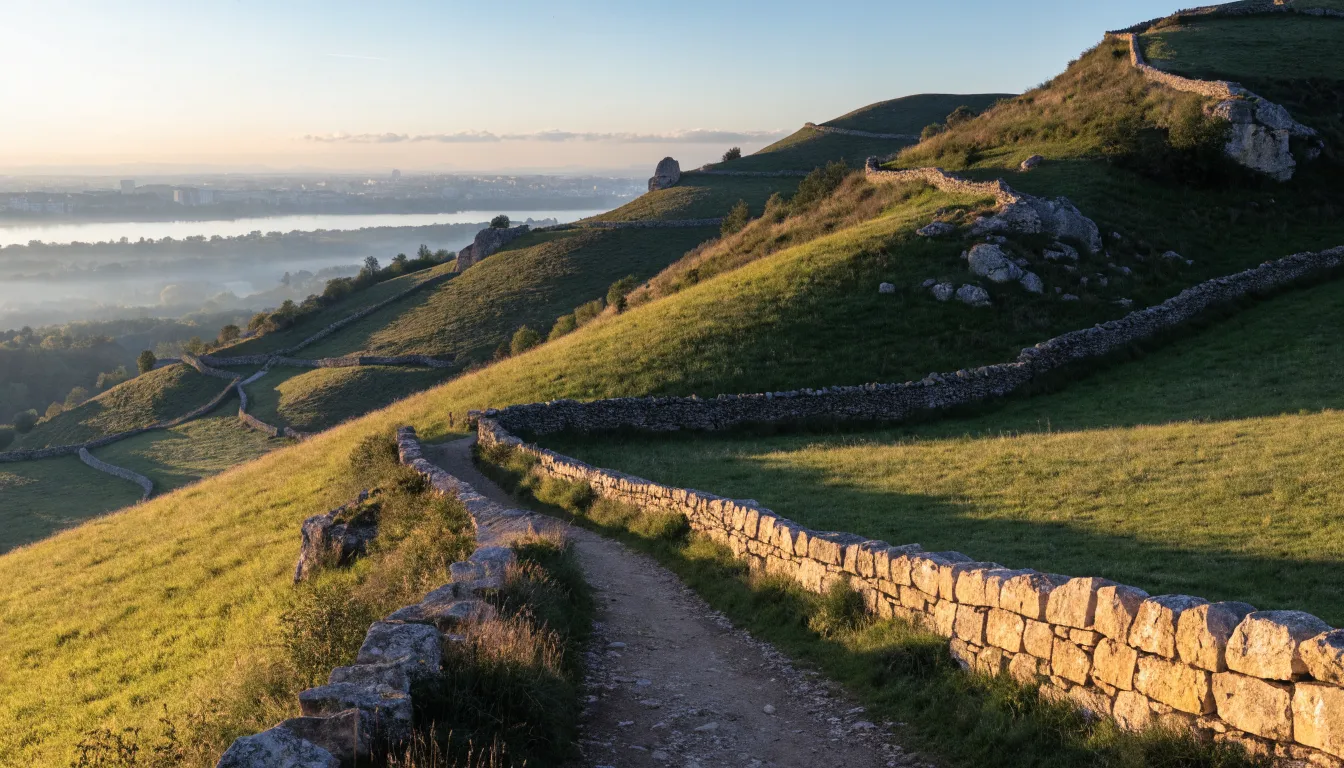
A quarter of an hour by car from central Lyon, the city stops dead and the limestone begins. The Monts d’Or are a dozen or so villages sitting on a small range north-west of the city, with summits that only just clear 600 metres and paths climbing up from the Saône. The name comes from the colour of the rock: a yellow limestone, quarried here for centuries, that you then find again on Lyon’s façades. Walking in the Monts d’Or means walking through the quarry that built the city.
It is also, very practically, the Sunday walk of Lyon locals. Not an expedition: a few hundred metres of climbing up from the river, as an order of magnitude, on broad, well-marked tracks. You pass as many families with pushchairs as runners. What follows is one possible way to string a full day together, from the ridges down to the Saône, with a museum on the way and two stone villages to finish.
The stops below are geolocated. Click “Show on map” to place a site, or “Directions” to start the route from where you are.
-
Mont Thou
The northern summit of the range, above Saint-Cyr-au-Mont-d'Or. You climb it on stony dirt tracks that cross meadows and stands of oak, and come out onto a wide view: the Saône valley below and, on a clear day, the Alps on the horizon.
Wear shoes with real grip, the limestone turns soapy after rain.
About 15 km from Lyon, in the order of 25 minutes by road to the north-west. Without a car, TCL buses climb into the range from Vaise, and the regional train follows the Saône to the villages at the foot of the slopes.
-
Mont Cindre
Lower than its neighbours, but facing Lyon. At the top sits a hermitage with its chapel and walled garden, placed exactly where the whole city lies in front of you. This is the family summit: the climb from Saint-Cyr is short and steady.
The view looks south-east. It is far better late in the day, when the sun lights the city up instead of shining straight into your eyes.
-
Mont Verdun
The high point of the Monts d'Or, a little over 600 metres. Its summit is taken up by a military site, closed to the public and bristling with aerials. So you walk around it, on the tracks above Poleymieux, and nothing is lost: the cleanest views are on the flanks, not on the ridge.
Do not try to get close to the fences, the zone is signposted. The open paths give the summit a wide berth.
-
Musée Ampère
In Poleymieux-au-Mont-d'Or, in the family house where André-Marie Ampère spent his childhood. You go through the house and a collection of instruments that tells the story of electricity, demonstrations included. The unit of current carries his name, and you leave finally knowing why.
Opening days and times change with the season. Check before driving up, the village is well away from everything.
-
Couzon quarries
This is where much of the yellow stone you see on Lyon's façades came from. The quarry faces are still standing, sheer, with tool marks you can read in the limestone. These days the site is a fixture for climbers from the Lyon area.
Stay on the paths: these are former quarries, with genuine drops and unstable ground.
-
Saint-Romain-au-Mont-d'Or
A village clinging to the slope above the Saône: narrow lanes, golden stone walls, steps between the houses and old washhouses. Half an hour is enough to walk through it, and it is the best place in the range to see what the local stone looks like once it is built into a wall.
The pin marks the centre of the commune, not a precise address. The old village is walked from there.
-
Collonges-au-Mont-d'Or
The way back to Lyon runs along the Saône. Collonges has two faces: the old village up the slope, all in stone, and the lower part beside the water, with its quays and its railway halt. The commune is also known well beyond the region for its cooking, though that is not something you decide on the morning itself.
The pin marks the centre of the commune. From here Lyon is only a few kilometres away, following the river.
1. Mont Thou
This is the northern summit, above Saint-Cyr-au-Mont-d’Or. You climb on stony dirt tracks that alternate between meadows and stands of oak, and the view arrives all at once at the top: the Saône valley below, the Beaujolais stretching away to the north, and on a clear day the Alps behind it all.
The detail that makes the difference: wear shoes with real grip. Wet limestone turns soapy, and the steeper sections of the path are far easier to handle with a lugged sole than with city trainers.
2. Mont Cindre
It is lower than its two neighbours, but it has one decisive advantage: it looks straight at Lyon. At the top sits a hermitage with its chapel and walled garden, placed exactly where the whole city fits into your field of view.
This is the family summit. The climb from Saint-Cyr is short, steady, with nothing technical, and plenty of locals do it on a Sunday morning without thinking twice. One piece of orientation advice: the view faces south-east, so come late in the day, when the sun lights the city up rather than shining straight into your eyes.
3. Mont Verdun, which you walk around
This is the high point of the range, a little over 600 metres, and it is also the one you do not climb. Its summit is occupied by a military site, closed to the public and recognisable from a distance by its aerials.
That is no disappointment, as long as you know it before setting off. The open paths give the summit a wide berth on the Poleymieux-au-Mont-d’Or side, and they are the ones with the best views: on a range like this, the clear sightlines are on the flanks, rarely on the wooded ridge. Do not try to get close to the fences, the zone is signposted.
4. The Ampère museum, at Poleymieux
At Poleymieux, the family house where André-Marie Ampère spent his childhood has become a museum. You go through the house itself, with its period rooms, and a collection of instruments retracing the history of electricity, demonstrations included.
It is the sort of place you do not expect in the middle of a walk, which is exactly why it works. The unit of electric current carries this man’s name, and you leave finally knowing why. Check opening days and times before driving up: they change with the season, and the village really is off on its own.
5. The Couzon quarries
You drop back down towards the Saône through Couzon-au-Mont-d’Or, and there the whole point of the range becomes visible. This is where much of the yellow stone on Lyon’s façades came from. The quarry faces are still standing, sheer, with tool marks you can still read in the limestone.
The site has found a second life: climbers from the Lyon area come here regularly. For everybody else the rule is simple, stay on the paths. A former quarry means genuine drops and patches of unstable rock, and it is not a place to cut corners across.
6. Saint-Romain-au-Mont-d’Or
A village clinging to the slope above the river: narrow lanes, golden stone walls, steps between the houses, old washhouses. Half an hour is enough to walk through it, and it is probably the best place in the range to understand what the local limestone gives once it is built into a wall and weathered by two centuries of rain.
The pin on the map marks the centre of the commune, not a precise address. That is deliberate: what you come for here is not a monument but a fabric of streets, and you walk it from the centre.
7. Collonges-au-Mont-d’Or
The last stop before Lyon, down beside the water. Collonges has two faces: the old village up the slope, all in stone, and the lower part along the Saône, with its quays and its railway halt. You can take both in one go, the climb between them is short.
The commune is also known well beyond the region for its cooking, but that is not an address you decide on the morning itself. Here too, the pin marks the centre of the commune.
Getting there from Lyon, by car or public transport
By car, reckon on about 15 km and in the order of 25 minutes from Lyon, heading north-west. It is the most flexible option for chaining several stops in a day, because the trailheads are scattered from one village to the next.
Without a car it works, and it is arguably the better idea. TCL buses climb into the range from Vaise, and the regional train follows the Saône to the villages at the foot of the slopes, Collonges and Couzon among them. From the river, you walk up. Check the day’s timetables before setting off: they change with the day of the week, and the Sunday service is not the weekday one.
A full day covers the lot without rushing. If you only have a morning, take Mont Cindre and then drop down to Saint-Romain: that is the most honest short version of the range.
Back in Lyon
The Monts d’Or slot neatly into a weekend in Lyon, precisely because they are quick. You leave after breakfast and you are back for a drink in the evening. If you are looking for other ways to fill the day, our guide to things to do in Lyon on a Sunday lists what stays open, and if you want to go further next time, Pérouges in a day heads off in the opposite direction.
And if the yellow stone left you curious about the link between limestone soil and what grows on it, our guided route takes place in vaulted cellars in the Guillotière district, for when you are back.