
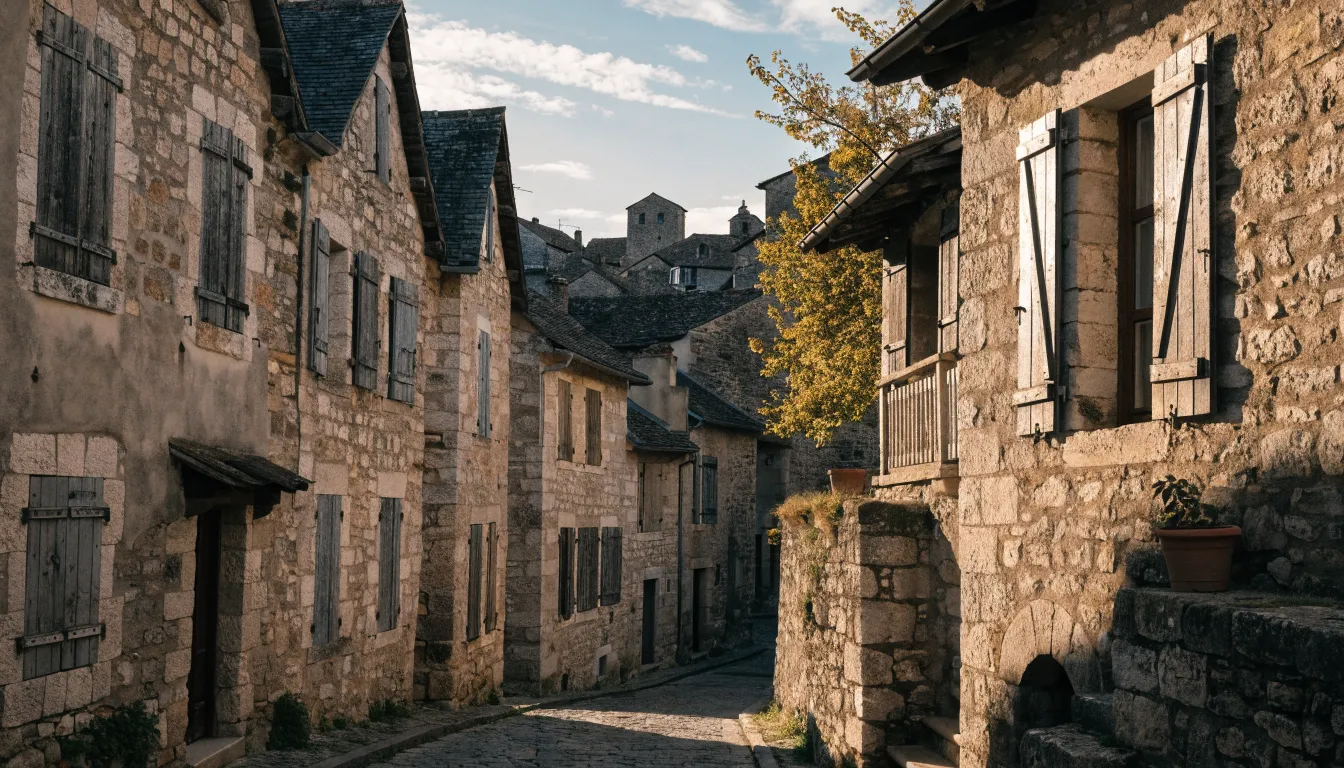
Some thirty kilometres east of Lyon, a low hill carries an entirely walled town. Pérouges lived off linen: people wove it here, sold it here, and the town counted hundreds of inhabitants. Then the industry mechanised elsewhere, the railway ran through the plain below rather than up the hill, and the village emptied. By the early 20th century only a handful of households were left, and houses were being pulled down for their stone.
What saved Pérouges was a small group of residents and scholars who decided, against every economic argument of the moment, that those houses were worth more than their masonry. A century later you walk through a restored town that has kept its medieval layout, its two gates and its cobbled streets. It is quick to see, it combines well with the Ain plain around it, and it makes a proper day out of Lyon.
The stops below are geolocated. Click “Show on map” to place a site, or “Directions” to start the route from where you are.
-
Pérouges medieval town
A walled village sitting on a low hill, with two gates, a ring of ramparts and streets paved in river cobbles. Once a town of linen weavers, it emptied out in the 19th century and came close to being pulled down before it was saved and restored.
Come early in the morning: the lanes are narrow and fill up quickly in season.
About 35 km from Lyon, roughly forty minutes by road. By train, Meximieux-Pérouges station, then a walk uphill to the village.
-
Place du Tilleul
The heart of the village: timber-framed houses, stone shopfronts, low arcades and a lime tree in the middle, planted around the time of the Revolution according to local tradition. This is where Pérouges breathes.
It is also the area where the galette de Pérouges, the local sugar tart, is sold.
-
Musée du Vieux Pérouges
Furniture, tools and everyday objects from the weavers' town, gathered in one of the old houses on the square. The clearest way to understand why the village emptied, and why people then fought to keep it standing.
The map pin marks the area around the square, not the exact entrance. Check opening days and times before you set off.
-
Sainte-Marie-Madeleine fortified church
Built into the ramparts near the upper gate, the church doubles as a bastion: thick walls, narrow openings, a façade with no ornament at all. Worship and defence in one building, and you can read it from the outside straight away.
-
Meximieux
The neighbouring town down in the plain, at the foot of the hill. Shops, cafés, everyday services and the station that serves Pérouges. This is where you stock up, and where you catch the train back to Lyon.
The pin marks the centre of the commune, not a precise address.
-
Château de Chazey-sur-Ain
A lordly castle above the river Ain, with towers and a curtain wall. It is privately owned: depending on the period, you either take it in from the outside or catch one of its occasional openings.
Check before making the trip, access to the castle is not guaranteed all year round.
-
River Ain at Villieu-Loyes-Mollon
The Ain, its gravel banks, its poplars and its riverside paths. A flat, shaded way to end the day after the hot stone of the walled village.
The pin marks the centre of the commune: river access points are spread along the banks.
1. The medieval town of Pérouges
Leave the car at the bottom and walk up: that is the right way to arrive, because the town only reveals itself once you are through the gate. Inside, the streets are paved with river cobbles, cambered in the middle for drainage, and the houses press against one another behind the ramparts.
The genuinely useful advice fits in one line: come early. The lanes are narrow, the village is small, and in season the crowd concentrates into a few hours around the middle of the day. An early arrival changes the experience completely.
2. The Place du Tilleul
This is the central square, lined with timber-framed houses and stone shopfronts under low arcades. In the middle stands a lime tree, planted around the time of the Revolution according to local tradition.
It is also the area where you will find the galette de Pérouges, the village’s sugar tart: thin dough, butter, sugar, baked fast in a hot oven. It is eaten warm, and it is the sort of thing several people share rather than each ordering their own.
3. The Musée du Vieux Pérouges
Set up in one of the old houses on the square, it brings together the furniture, tools and everyday objects of the weavers’ town. It is a modest museum and that is exactly the point: in a few rooms you grasp what these people did, why they left, and how the restoration was carried out.
Check the opening days and times before you set off, they are not the same all year round.
4. The fortified church of Sainte-Marie-Madeleine
It backs onto the ramparts near the upper gate, and it was built to hold: thick walls, narrow openings, a façade with no ornament. From the outside you hesitate between a church and a bastion, which is precisely what it is. Both functions were designed together, and that says a good deal about life in a medieval border town.
Inside, the contrast with the façade is worth the visit on its own.
5. Meximieux, down in the plain
Pérouges lives up on its hill, but everyday life happens below, in Meximieux. It is the neighbouring town, with its shops, its cafés, its services and the station that serves the area.
In practice this is where you stock up during the day, especially if you came by train: you arrive here and you leave from here. The pin on the map marks the centre of the commune, not a precise address.
6. The Château de Chazey-sur-Ain
Ten kilometres or so further east, a lordly castle overlooks the river Ain with its towers and curtain wall. It is privately owned: depending on the period, you either take it in from the outside or catch one of its occasional openings.
Check before making the trip. Access is not guaranteed all year round, and it would be a shame to drive out there and find the gate shut.
7. The river Ain at Villieu-Loyes-Mollon
To finish the day, drop down to the river. The Ain is not spectacular at first glance, but it has gravel banks, poplars and riverside paths that do exactly what you want of them in late afternoon: flat ground, shade and water.
After a morning on the hot stone of the walled town, it is the right counterpoint. The pin marks the centre of the commune, and river access points are spread along the banks.
Getting there from Lyon, by car or by train
By car, reckon on about 35 km and roughly forty minutes from Lyon, heading east. You park below the town, since driving inside the walls makes no sense.
By train, it works without a car: one station serves the area, Meximieux-Pérouges. From the station you then walk up to the town, allowing a good twenty minutes or so on foot, with a climb at the end. Check the timetable for your day before leaving, it varies with the day of the week.
One day is plenty for the whole route. If you only do the walled town, half a day covers it, and you can be back in Lyon for lunch.
Back in Lyon
Pérouges pairs well with a Lyon weekend: one day out, the rest in town. If you are planning the stay, our guide to things to do in Lyon on a weekend covers the essentials as locals see them, and the 2-day Lyon itinerary sets out a full schedule.
And if the day in the Ain left you curious about vines and terroir, our visit route runs through 19th-century vaulted cellars in the Guillotière district, for when you get back.