
Some thirty kilometres south of Lyon, on the left bank of the Rhône, Vienne is the easiest Roman day out you can make from the city. This is not Vienna in Austria, and not the town in the Vienne department either: this one sits in the Isère, it was called Vienna in Latin, and it was one of the wealthiest cities of Roman Gaul.
What makes the day simple is the geography. A regional TER train links Lyon to Vienne in well under an hour, and once you step out of the station everything is walkable. A near-complete temple in the middle of a square, a theatre carved into the hillside, and across the water an entire Roman district cleared at ground level: that is a lot for a town this size.
Every stop is mapped below. Tap “Show on map” to place a site, or “Directions” to start navigating.
-
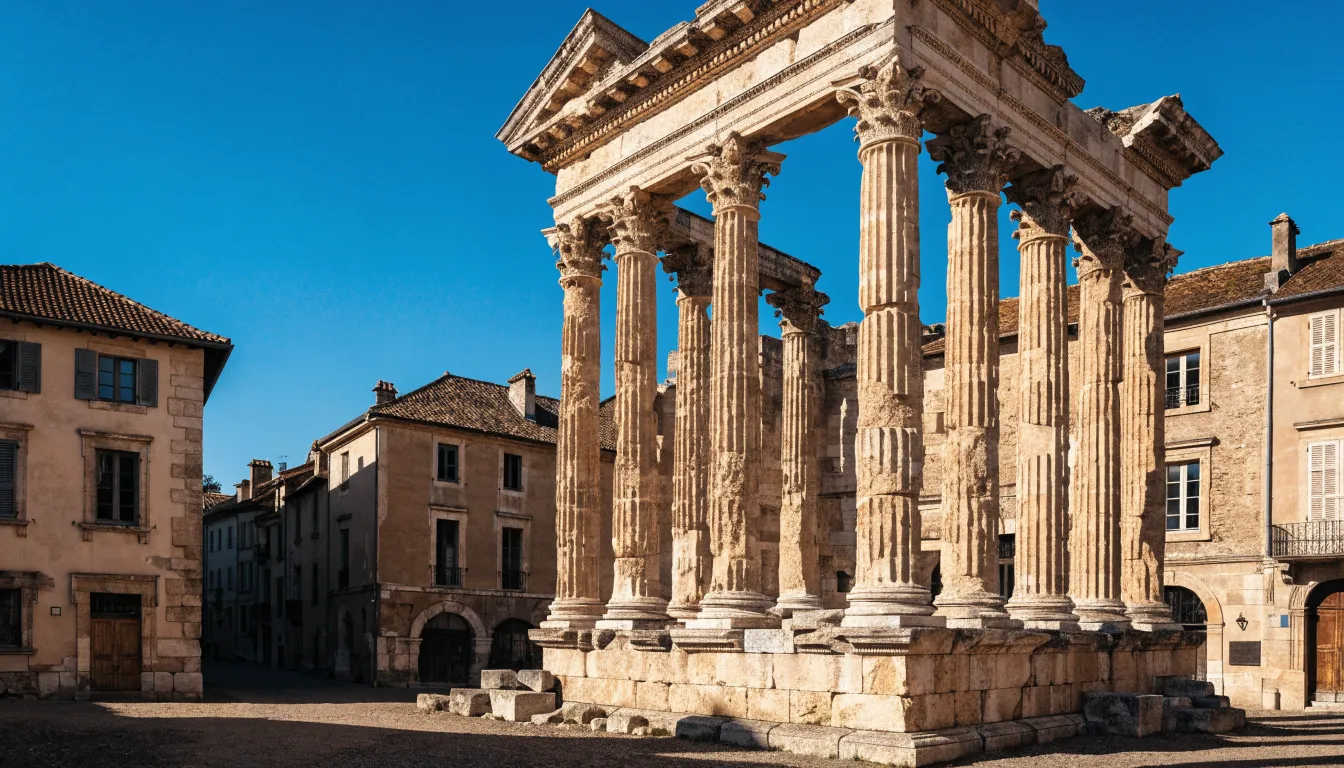
Temple of Augustus and Livia
A Roman temple still standing in the middle of a square, Corinthian columns included. It survived because it was recycled into a church, then a public building, instead of being quarried for stone.
Walk right around it: the facade reads from a distance, the ancient masonry reads up close.
A few minutes on foot from Vienne station, in the Isère, south of Lyon.
-
Saint-Maurice cathedral
Its long facade faces the Rhône quayside. Building dragged on for centuries and it shows: look up along the nave and you move from Romanesque to Gothic.
The portals were mutilated during the Wars of Religion, and the damage is still legible.
-
Saint-André-le-Bas cloister
A Romanesque gallery around a square garden, out of the noise. The carved capitals are worth taking one at a time, and the courtyard stays cool when the town heats up.
A good mid-morning stop, when you need to sit down for five minutes.
-
Roman theatre of Vienne
Cut into the hillside, one of the largest theatres in Roman Gaul. Climb the tiers and the town falls into place below you, with the Rhône behind it.
This is where the Jazz à Vienne festival is held; when the stage is being built, access can change.
-
Mont Pipet viewpoint
The hill directly above the theatre, with its chapel. From up there the geography of Vienne clicks: the river, the old town, the tiers seen from behind.
It is a climb. Sensible shoes, and a pause before heading back down.
-
Saint-Romain-en-Gal archaeological site
On the far bank of the Rhône, in the Rhône department, a whole Roman district cleared at ground level: streets, warehouses, houses with mosaics, workshops. The museum alongside displays the lifted pavements.
The map pin marks the commune, not the entrance: follow the signs once you have crossed the footbridge.
From Vienne you cross the Rhône on foot by the footbridge.
-
Pyramid of the Roman circus
An obelisk on a four-arched base, standing at the southern edge of town. It stood on the central barrier of the Roman circus, and local tradition long took it for the tomb of Pontius Pilate.
The logical last stop before the train back, since it sits on the way in towards the centre.
1. The Temple of Augustus and Livia, right in the centre
This is the opening shock. You leave the station, walk a few minutes, and a complete Roman temple stands in the middle of a square, surrounded by shops and café terraces. Corinthian columns, pediment, steps: the whole silhouette is there.
It survived through constant reuse. Turned into a church, then given other public functions over the centuries, it was never quarried for its stone, unlike most ancient monuments in the area. Take the time to walk all the way around it: from a distance you read the facade, up close you read the masonry.
2. Saint-Maurice cathedral, facing the river
A few streets down, Saint-Maurice cathedral lines up its long facade towards the Rhône. Construction dragged on for centuries and it shows: the nave changes language as you move along it, from Romanesque towards Gothic.
Look at the portals before going in. The statues were mutilated during the Wars of Religion, and the damage was never smoothed over. It is one of the rare places where the town’s turbulent history reads straight off the stone, with no interpretation panel needed.
3. Saint-André-le-Bas cloister, the cool pause
The Saint-André-le-Bas cloister is small, and that is precisely what makes it pleasant. A Romanesque gallery, a square garden, and carved capitals you can genuinely study one by one because they sit at eye level.
It is also the best place of the morning to sit down for five minutes. The courtyard stays cool when the town heats up, and traffic noise stops dead at the entrance.
4. The Roman theatre, built into the hill
Head east and uphill. The Roman theatre of Vienne is cut into the flank of Mont Pipet, following the classic Roman principle: use the slope instead of building the tiers. It is one of the largest theatres in Roman Gaul, and the scale really registers on the way up.
From the top rows the town falls into place below you, with the Rhône behind it. This is where the Jazz à Vienne festival is held each year: when the stage is being built, access can be reorganised, so it is worth checking before you climb.
5. The Mont Pipet viewpoint, to make sense of the town
Just above the theatre, the hill carries on up to the chapel on Mont Pipet. It is a proper climb, but it is the viewpoint that ties the whole day together: the river, the old town, and the tiers of the theatre seen from behind.
Bring sensible shoes and plan a pause at the top. The descent back into the centre is gentle.
6. Saint-Romain-en-Gal, a Roman district in the open air
This is the part that surprises people most. You cross the Rhône on foot by the footbridge, changing bank and changing department, and arrive at a whole Roman district cleared at ground level: streets, warehouses, shops, workshops, houses with mosaic floors. The museum alongside displays the lifted pavements and puts the layout back into context.
This is where it clicks that Vienne was not a small provincial town with a few monuments, but a settlement spread across both sides of the river.
One navigation note: the map pin marks the commune of Saint-Romain-en-Gal, not the exact entrance to the site. Once across the footbridge, follow the signs.
7. The pyramid of the Roman circus, on the way back
At the southern edge of town, the pyramid is an obelisk on a four-arched base, now planted in the middle of an ordinary neighbourhood. It stood on the central barrier of the Roman circus, in other words the axis the chariots turned around.
Local tradition long held it to be the tomb of Pontius Pilate, for which there is no evidence at all. It makes the logical last stop of the day, sitting on the walk back in towards the centre and the station.
Planning the day
- Getting there: TER trains serve Vienne from Lyon, the journey is short and the station is central. By car, allow around thirty kilometres down the left bank of the Rhône. The train is the more comfortable option, since everything else is done on foot.
- The order of visits: start with the centre in the morning, climb to the theatre and Pipet before the heat, and keep Saint-Romain-en-Gal for the afternoon. That is the least tiring direction of travel.
- Closing days: the archaeological sites and monuments each run their own calendar, and some close one day a week. Check before you set off rather than once you are there.
- The market: Vienne has a market with a real reputation in the region, big enough to change the shape of the centre. Look up which day it falls on if you want to catch it, or avoid it.
- The gradient: the old town is flat, the theatre and Pipet are not remotely flat. Choose footwear accordingly.
Back in Lyon
Vienne works well as a day out: you leave in late afternoon and you are back in Lyon for the evening. If you are building a longer stay, our guide to things to do in Lyon over a weekend frames the next two days, and the Lyon gastronomy guide takes over on the food side.
And if the day left you curious about what grows in the Rhône valley you have just followed, the museum route is in the Guillotière district of Lyon; the practical information page covers opening times and access.
Vienne is a town you visit with your feet, and it tells its own story.