
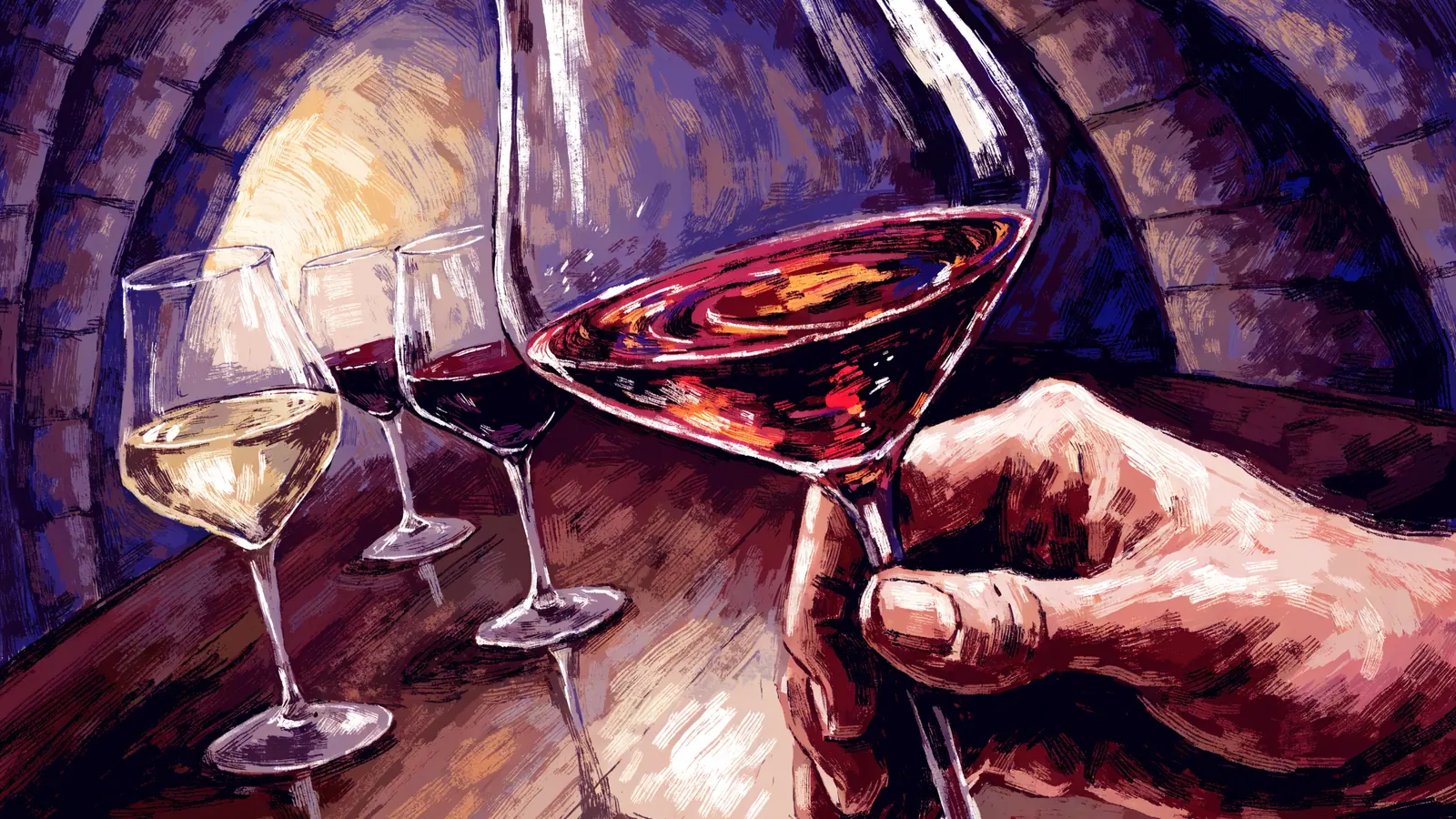
Tasting a wine means looking at it, smelling it, then tasting it, taking the time to put words to what you notice. You do not need expert vocabulary or an exceptional palate: the method takes a few glasses to learn, and it is mostly a matter of attention and comparison.
Tasting is not the same as drinking
Drinking is about quenching your thirst or going with a meal. Tasting means using your senses to describe and understand a wine. You take a little, look at it, smell it more than once, hold it in your mouth for a moment. The aim is not to find “the right answer”, but to be able to say what you like, and why.
Step 1: look at the wine
Tilt the glass slightly against a light background (a tablecloth or a sheet of paper) and observe:
- The colour: pale yellow to gold for a white, salmon to raspberry for a rosé, ruby, garnet or purple for a red.
- The depth: a pale colour often signals a lighter wine, a deep one a more concentrated wine.
- The clarity: wine is usually clear; a light deposit in an old red is normal.
- The legs (or tears): drops running down the glass mainly tell you about alcohol and sugar, not quality.
Step 2: smell the wine
This is the richest step, because most of what we call “taste” actually comes through the nose.
- First nose, glass still: bring your nose close and breathe calmly. You pick up the most volatile aromas.
- Second nose, after swirling: swirl the wine for a few seconds, then smell again. The wine “opens up” and shows other aromas.
To describe it, think in families: fruit (red, black, white, citrus, tropical), flowers, spices, green notes (cut grass, bell pepper), oak (vanilla, toast), earthy or animal notes. Professionals sort aromas by origin:
- Primary aromas come from the grape and the variety (fruit, flowers).
- Secondary aromas appear during fermentation (brioche, butter, yeast).
- Tertiary aromas develop during ageing (vanilla, leather, mushroom, dried fruit).
Step 3: taste the wine
Take a small sip and keep it in your mouth for a few seconds, moving it around. There are three moments:
- The attack: the first impression, soft or lively.
- The mid-palate: the balance between sugar (sweetness), acidity (freshness, which makes your mouth water), alcohol (a warming sensation) and, in reds, tannins, which dry your gums like over-brewed tea.
- The finish: what stays after you swallow or spit. How long the flavours linger is called length, sometimes counted in caudalies (one caudalie, one second).
A wine is called balanced when none of these elements overwhelms the others.
The right conditions for tasting
- The glass: stemmed and tulip-shaped, so the aromas gather towards your nose. Hold it by the stem so you do not warm the wine.
- How much: a third of the glass at most, so you can swirl.
- The order: lightest to most powerful, dry white before red, dry before sweet.
- The setting: avoid perfume, chewing gum or coffee just before; drink water between wines.
- Spitting is not rude: at a tasting it is standard practice when you try many wines.
The most common beginner mistakes
- Going too fast: drinking before smelling. The nose often tells you more than the mouth.
- Hunting for the exact aroma: “red fruit” is already a very good description.
- Relying on your neighbour: perception varies from person to person; what you notice counts.
- Judging a wine on its own: comparing two wines side by side is the quickest way to learn.
Where to practise in Lyon as a beginner
At the Petit Musée du Vin, 3 rue Passet (Lyon 7th), a tour of about an hour prepares you for the tasting: the history of wine, terroirs, winemaking and the trades of the vine, before you taste 8 wines.
An accompanied tasting, not a self-service bar. You taste at your own pace, with no one rushing you, but never alone in front of the glasses. A member of the team is present throughout the tasting: you can ask them your questions, and 3 of the 8 wines, chosen by the museum, are talked through with you. The team is trained in-house in tasting and in the wines being poured.
The visit costs €32 at full price and €25 at the reduced rate, with proof of eligibility. To go further, the wine tasting initiation sessions and the museum’s other events are listed in the events calendar.
To understand why two wines from the same grape taste different, read our guide to French wine terroirs.
Frequently asked questions
What are the steps of a wine tasting?
Three steps, always in the same order: look at the wine (colour, depth, clarity), smell it (first with the glass still, then after swirling), then taste it (attack, mid-palate, finish).
Should you swirl the wine in the glass?
Yes, after a first sniff with the glass still. Swirling lets air into the wine and releases more aromas. Hold the glass by the stem and fill it no more than a third so you can swirl without spilling.
What do the “legs” or “tears” of a wine mean?
They are the drops that run back down the inside of the glass. They mainly reflect the wine’s alcohol and sugar, not its quality.
What is the length of a wine?
It is how long the flavours linger after you swallow or spit. It is sometimes counted in caudalies: one caudalie equals one second.
Where can a beginner learn to taste wine in Lyon?
At the Petit Musée du Vin (3 rue Passet, Lyon 7th), a tour of about an hour ends with a tasting of 8 wines, 3 of them talked through by a team member who stays with you throughout. €32 full price, €25 reduced rate with proof of eligibility.