
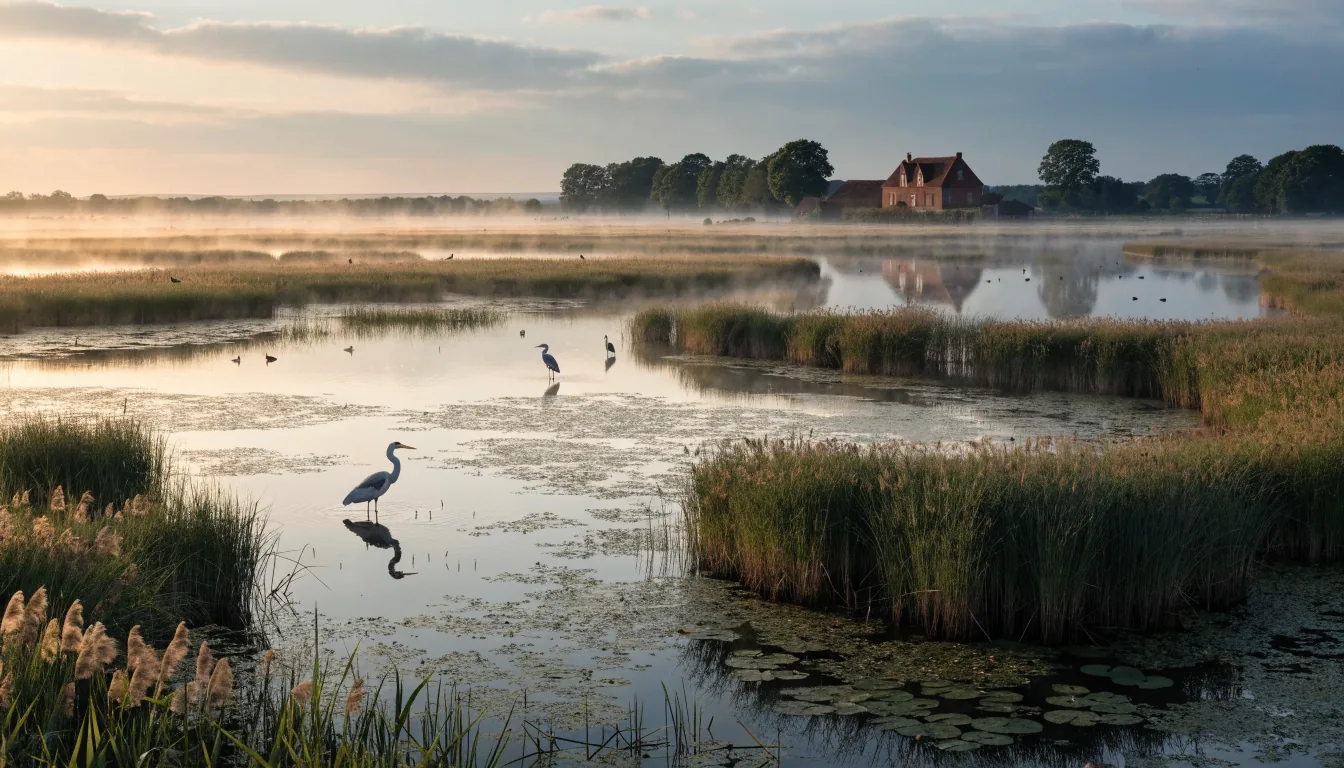
Three quarters of an hour north-east of Lyon, the road stops climbing. The Dombes plateau is flat, it is clay, and there is water everywhere: ponds separated by dykes, edged with reeds, with red brick farms set down between them. On a misty morning you can drive ten kilometres and see little else but reflections, willows and the outlines of birds at the water’s edge. It is not a landscape that fits into one photograph. You have to drive through it.
These ponds are not natural. They were dug from the Middle Ages onwards, on a clay soil that holds water, and they have been worked in alternation ever since: a few years in water, which is called évolage, with fish raised in them; then they are drained, left to dry and the bed is sown, which is called assec. That back and forth explains everything else. It explains the landscape, which differs from one pond to the next and from one year to another. It explains the local cooking, built around carp and pike. It even explains the architecture, because a country of clay makes bricks rather than cutting stone.
It is also an easy destination with children, and that is probably its best quality. Everything is flat, the distances between stops are measured in minutes, the bird park at Villars-les-Dombes takes up a good part of the day on its own, and the rest comes in small doses, stopping when it is worth it. What follows is one possible loop for a day, in the order you drive it from Lyon.
One precaution before you set off: the great majority of the ponds in the Dombes are private property, worked for fish farming. You watch them from the roads and from open tracks, never from the banks, and you do not step over a fence to get closer to the water. In the hunting season, pay particular attention to the signs: they are there for you.
The stops below are geolocated. Click “Show on map” to place one, or “Directions” to start the route from where you are.
-
Parc des Oiseaux, Villars-les-Dombes
The bird park at Villars-les-Dombes is what anchors the day if you are coming with children. You follow a walking route between aviaries and enclosures, among birds from several continents, on a site laid out beside the ponds. Allow time for it: this is a visit you do on foot, and children tend to stop for longer than you planned.
Opening season, hours and prices vary through the year. Check them on the park's official website before you set off: we do not reproduce them here, because they change.
In the order of 40 km from Lyon, about 45 minutes by road to the north-east. By train, the Lyon to Bourg-en-Bresse regional line stops at Villars-les-Dombes; the rest of the loop then needs a car or a bike.
-
Château de Bouligneux
A red brick fortress standing at the edge of a pond, a few kilometres north of the park. It is the picture you keep of the Dombes: brick, water, reeds, and nothing else around. The château is private property. You look at it from the road and from the village, which is quite enough to understand why it was built there.
Do not expect to go in. Stay on the road and on open tracks: the banks of the pond belong to private owners.
-
Châtillon-sur-Chalaronne
The town the Chalaronne runs through, and the stop where you walk the most. Everything here is brick: the houses, the arcades, what is left of the medieval walls. A timber market hall stands at the centre. Vincent de Paul was parish priest here in the early seventeenth century, and the old hospital keeps its apothecary's dispensary. It is the handiest point on the loop for a break in the middle of the day.
The pin marks the centre of the commune. For the dispensary and the municipal collections, check the visiting arrangements locally.
-
Saint-Paul-de-Varax
A village among ponds, with a Romanesque church whose carved doorway is worth the stop even if Romanesque art is not your thing. It is also a good place to grasp the rhythm of the country: around the village some ponds are in water, others drained and sown, and it changes from one year to the next.
Park in the centre and walk round the church. The tracks heading off towards the ponds are often private accesses: read the signs before you follow one.
-
Abbaye Notre-Dame-des-Dombes, Le Plantay
An abbey founded in the nineteenth century by Cistercian monks, out in the wetlands, at a time when the plateau was being drained and made healthier. The brick buildings show up from a long way off above the fields. The site is now home to a religious community: what can be visited depends on the life of the place, and you cannot guess it from the road.
Check on site, or with the community, what is open to the public on the day you come. A lived-in abbey is not a monument.
-
Chalamont
The village occupies the higher part of the plateau, which in the Dombes means a few dozen metres, but that is enough to open up the view over the ponds. An old sloping street keeps its half-timbered and brick houses. It is a place people drive through rather than a sight, and that is exactly why it is worth stopping.
The old street takes a few minutes on foot. Parking is easier at the bottom of the village than at the top.
-
Étangs de Joyeux
On the way back towards Lyon, the commune of Joyeux gives you the landscape undiluted: narrow roads running from one pond to the next, dykes, reeds, and birds you hear before you see them. This is where the word évolage makes sense. The pond is in water and fish are raised in it, then it is drained and the bed is cropped: the Dombes has lived on that alternation since the Middle Ages.
The pin marks the centre of the commune, not a laid-out viewing point. The ponds are private: you look from the road or from an open track, never from the banks. In the hunting season, pay particular attention to the signs.
1. The Parc des Oiseaux at Villars-les-Dombes
This is what anchors the day if you are coming with children, and the only place on the route that genuinely needs time set aside. The bird park at Villars-les-Dombes offers a walking route between aviaries and enclosures, among birds from several continents, on a site laid out beside the ponds. You walk a lot, and children usually stop for far longer than planned in front of two or three enclosures they have picked themselves.
A word of honesty about the practical details: the opening season, the hours and the prices vary through the year, and we are not copying them out here, because they change. Check them on the park’s official website before you leave. It takes two minutes and it saves you forty kilometres for nothing.
If you are coming with young children, start here rather than saving the park for the afternoon. The rest of the loop is made of short stops, which are much easier to negotiate once the main event is behind you.
2. The château de Bouligneux, brick and reeds
A few kilometres north of the park, a red brick fortress stands at the edge of a pond. It is the picture you keep of the Dombes: brick, water, reeds, and nothing else around to distract the eye. The contrast between the red of the walls and the green of the water is what stays with you, especially late in the day.
The château is private property. You look at it from the road and from the village, which is quite enough, and you do not try to work round it along the banks: those belong to someone as well. This is a ten minute stop, not a visit, and it is fine that way.
3. Châtillon-sur-Chalaronne, the midday break
Head north to the town the Chalaronne runs through. This is the stop where you walk the most, and the handiest place to break in the middle of the day. Everything here is brick: the houses, the arcades, what is left of the medieval walls. A timber market hall stands at the centre, and the river passes under several bridges, which gives the town a shape that is easy to follow on foot with children.
Vincent de Paul was parish priest here in the early seventeenth century, and the old hospital keeps its apothecary’s dispensary, with the faience jars lined up on the original shelves. For the dispensary as for the municipal collections, ask locally about the visiting arrangements: we are not stating them, and they cannot be guessed from the street.
The pin on the map marks the centre of the commune. That is enough here: once you have parked, the old town is done entirely on foot.
4. Saint-Paul-de-Varax, the Romanesque doorway and the ponds
Turn east. Saint-Paul-de-Varax is a village among ponds with a Romanesque church whose carved doorway is worth the stop, even if Romanesque art is not your subject for the day. Walking round the church is enough to see what stone was doing here, in a country that builds in brick.
It is also a good place to grasp the rhythm of the country. Around the village some ponds are in water and others drained and sown, and the pattern shifts from one year to the next. Come back in three years and it will not be the same ones catching the light.
The tracks heading off towards the ponds are often private accesses. Read the signs before you follow one, and stay on the roads if you are in any doubt.
5. The abbey of Notre-Dame-des-Dombes, at Le Plantay
A few kilometres on, brick buildings appear above the fields, visible from a long way off. The abbey of Notre-Dame-des-Dombes was founded in the nineteenth century by Cistercian monks, out in the wetlands, at a time when the plateau was being drained and made healthier: the Dombes then had a reputation as fever country, and part of the ponds were dried out for that reason.
The site is now home to a religious community. What can be visited depends on the life of the place, and you cannot guess it from the road. Check on site, or with the community, what is open to the public on the day you come: a lived-in abbey is not a monument, and the reception desk is not a ticket office.
6. Chalamont, the high point of the plateau
Chalamont occupies the higher part of the Dombes, which here means a few dozen metres. Not much, but enough to open up the view and to make sense of how the plateau is organised: the water works its way down from one pond to the next, in chains, each feeding the one below.
The village itself is small. An old sloping street keeps its half-timbered and brick houses and takes a few minutes to walk. It is not a sight, it is a place people drive through, and that is exactly why it is worth stopping: you get to see what the Dombes looks like when it is not receiving anyone.
Park at the bottom rather than the top, it is simpler.
7. The ponds of Joyeux, on the way back
Last stop, on the road running back down to Lyon. The commune of Joyeux gives you the landscape undiluted: narrow roads passing from one pond to the next, dykes, reeds, and birds you hear before you see them. It is the best place on the loop to switch off the engine, wind the window down and listen.
It is also where the alternation the region lives on becomes concrete. One pond in water, another dry on the far side of the road, wheat or maize growing on the bed of one that was under water two years ago. The Dombes has turned like that since the Middle Ages.
The pin on the map marks the centre of the commune, not a laid-out hide. The ponds are private: you look from the road or from an open track, never from the banks. And in the hunting season, be doubly attentive to the signs before setting off down a track.
Getting there from Lyon, by car, by train or by bike
By car, reckon on the order of 40 km and about 45 minutes from Lyon to Villars-les-Dombes, heading north-east. It is the simplest option, and much the best suited if you are doing all seven stops: they are spread over some twenty kilometres, with no public transport linking them.
By train, it is partly feasible. The Lyon to Bourg-en-Bresse regional line stops at Villars-les-Dombes, which makes the bird park a car-free day out. The rest of the loop, though, needs a car or a bike. Check the day’s timetables before you leave, they change from one weekday to another.
By bike, the Dombes is a rare thing this close to Lyon: it is flat, the minor roads are quiet, and the distances between stops come to ten kilometres or so. With children who already ride, a half loop around Villars, Bouligneux and Joyeux is more realistic than a full day, and a great deal more pleasant than driving out and back.
With children, do not aim for all seven stops. The bird park in the morning, a break at Châtillon-sur-Chalaronne at midday, a halt at Bouligneux and a last one out towards Joyeux late in the afternoon: the day is full already, and nobody comes home wrecked.
Back in Lyon
The Dombes slots easily into a stay in Lyon: you leave after breakfast, you are back before dinner, and you have changed landscape without covering much ground. If you are after more outings of this kind with children, our selection of family activities in Lyon stays inside the city, and our day in Pérouges heads the same way, eastwards, to a medieval town you visit entirely on foot.
And if you come back wanting to stay somewhere cool for another hour, our guided route takes place in vaulted cellars in the Guillotière district, in Lyon itself. After a day spent looking at water and brick, working out how a soil ends up in a glass rounds things off rather well.