
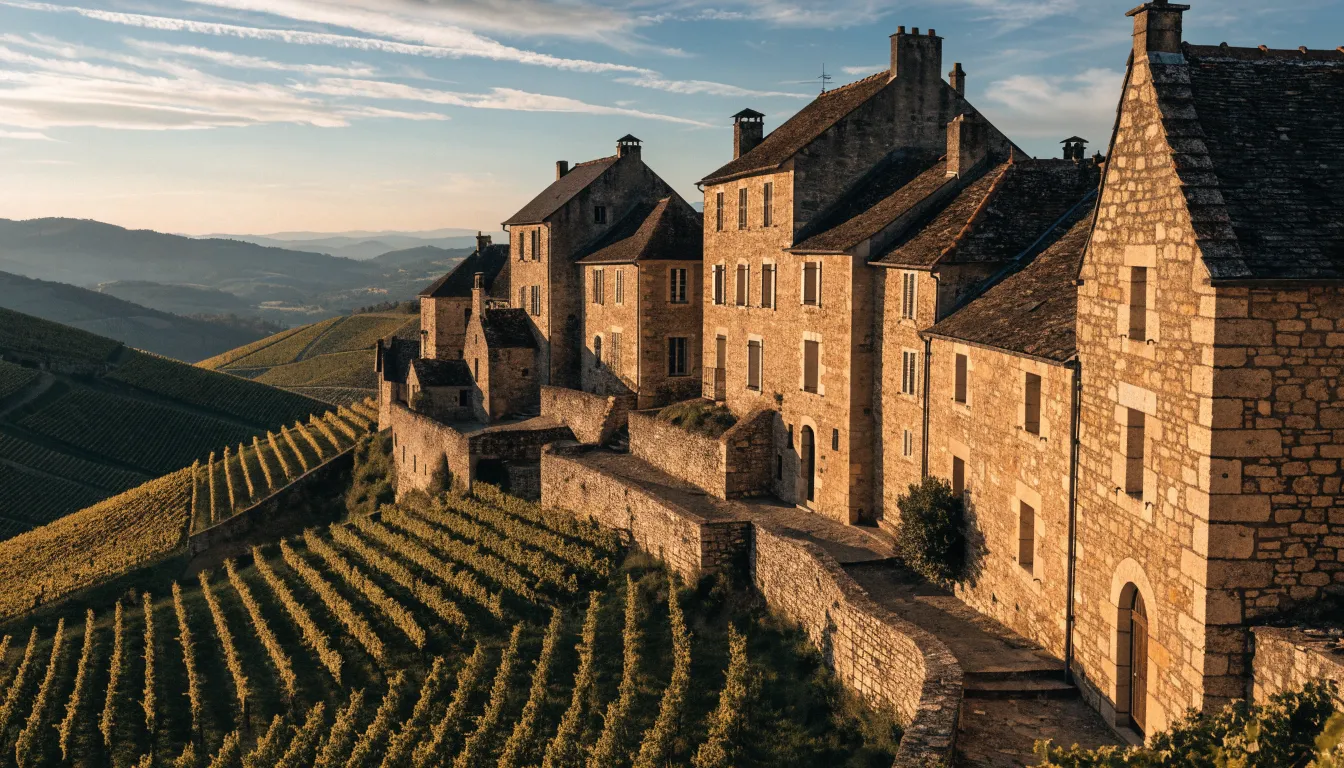
Forty minutes or so north-west of Lyon, the landscape changes colour. The roofs stay the same, so do the vines, but the walls turn yellow: a honey yellow, faintly pink in the evening, which has given its name to a whole corner of the southern Beaujolais, the Pierres Dorées, the golden stones. This is not brochure language, it is geology. The local limestone contains iron oxide, and that is what tints the rock. Cut, built into a wall and left out in the rain for two centuries, it takes on the warm colour you find from one village to the next across some thirty communes.
The right way to see the area is not to pick one village but to string several together, because the stone reveals itself through repetition: the same rock, handled differently depending on whether you are building a church, a barn or a vineyard wall. What follows is one possible day loop, in the order you drive it, from the best known village to the copper hills on the way home. On an autumn Sunday, when the vines turn red and the light rakes across the walls, it is probably the best time of year to do it.
The stops below are geolocated. Click “Show on map” to place a site, or “Directions” to start the route from where you are.
-
Oingt
The best known village around here, and the only one in the Beaujolais listed among the Plus Beaux Villages de France. It sits on a knoll, built entirely from the local ochre limestone, and the old centre is walked on foot: a fortified gate, lanes that climb, the church at the top and the tower looking out over the vines.
Leave the car at the bottom and walk up. The lanes are narrow, steep and cobbled.
In the order of 35 km from Lyon, about 45 minutes by road to the north-west. By train, the regional line runs up the Azergues valley, but you then need a car or a bike to get from one village to the next.
-
Château de Bagnols
Coming back down from Oingt towards the east, the outline of the château de Bagnols appears above the vines, towers and dry moat included. It is private property: you do not wander through it as you would a public monument. The village of Bagnols, on the other hand, is open, and its edges give the best view of the whole thing.
Do not count on walking into the château. Ask locally if you want to know what is accessible on the day you pass through.
-
Theizé
A village spread across several hamlets on a slope of vines, quieter than Oingt and far less visited. It is the best place to see what golden stone does at small scale: boundary walls, barns, outside staircases, window surrounds. A château and an old church stand on the terrace overlooking the vineyard.
The pin marks the centre of the commune, not a precise address: the village is scattered, so expect a little driving between hamlets.
-
Ternand
A former fortified village set on a spur, at the western edge of the area. Sections of rampart remain, along with a gateway and a tiny centre you can cross in a quarter of an hour. The church holds elements a good deal older than the rest of the village. From the top, the view runs down the Azergues valley towards the first hills of the green Beaujolais.
The pin marks the centre of the commune. Parking is limited at the top of the village: better to leave the car below and finish on foot.
-
Chamelet
A valley-floor village beside the Azergues, with an old covered market hall at its centre and houses packed along a climbing street. It is the northernmost stop on the loop, and the one where golden stone starts to mix with greyer rock: you are quietly leaving the ochre zone.
The pin marks the centre of the commune. The village is small, everything is done on foot once you have parked.
-
Château de Châtillon-d'Azergues
On the way back, a fortress planted on a rocky promontory above the village and the river. It is clearly visible from the road, and that is already a lot: the position alone explains why anyone built here. An old chapel stands beside the château.
The site is private. Look at it from the village or from the road, and check locally what is open on the day you come.
-
Chessy-les-Mines
The name of the commune says the essential thing: copper ore was mined in these hills. Chessy minerals are known to collectors, to the point that a variety of azurite picked up chessylite as its common name. The village itself is still a golden-stone place, the last stop before the run back down to Lyon.
The pin marks the centre of the commune. Do not assume the former mine workings can be visited: check first.
1. Oingt, the one you remember
It is the best known village in the area, and the only one in the Beaujolais listed among the Plus Beaux Villages de France. It sits on a knoll in the middle of the vines, built entirely from ochre limestone: a fortified gate, sloping lanes, the church at the top, and the tower standing over everything else.
The practical advice is simple: leave the car at the bottom and walk up. The village streets are narrow, cobbled and steep, and in any case Oingt is a place you see on foot. Allow a good hour to go round without rushing, more if you stop in the craft workshops and shops that occupy some of the upper houses.
One honest note: it is also the busiest stop on the loop. Arrive in the middle of the day on a summer Sunday and you will not have it to yourself. That is one more reason to start here and keep the rest of the day for quieter villages.
2. Château de Bagnols, seen from the vines
Coming back down from Oingt towards the east, the outline of the château de Bagnols appears above the vineyard, towers and dry moat included. It is private property: do not expect to wander through it as you would a public monument, and be wary of itineraries that suggest otherwise.
That is no great loss, because the interest here is in the whole picture. The village of Bagnols is open, and it is from its edges that the siting makes most sense: a fortress on a rise, vines all around, nothing breaking the line. If you want to know what is accessible on the day you pass through, ask locally rather than trusting a web page.
3. Theizé, the stone at small scale
Theizé is the typical Pierres Dorées village you drive through without noticing: spread across several hamlets on a slope of vines, quieter than Oingt and far less visited. Which is exactly why it is the best place to see what golden stone does day to day, away from the monuments: boundary walls, barns, outside staircases, window surrounds. A château and an old church stand on the terrace above the vineyard.
The pin on the map marks the centre of the commune, not a precise address. That matters here: the village is scattered, and you will need to drive a little between hamlets. Plan on stopping twice rather than once.
4. Ternand, the old fortified village
Head west. Ternand sits on a spur, well off the busy roads, and the register changes completely: it is no longer the vineyard that dominates but the defences. Sections of rampart remain, along with a gateway and a tiny centre you can cross in a quarter of an hour. The church holds elements a good deal older than the rest of the village.
From the top, the view runs down the Azergues valley and across to the first hills of the green Beaujolais, more wooded and more closed in. You can feel yourself leaving wine country.
The pin marks the centre of the commune. Parking is limited at the top of the village: better to leave the car below and finish on foot, which takes three minutes.
5. Chamelet, beside the Azergues
Chamelet is a valley-floor village on the riverbank, with an old covered market hall at its centre and houses packed along a climbing street. It is the northernmost stop on the loop, and the one where the subject quietly shifts: golden stone starts to mix with greyer rock, and you are leaving the ochre zone.
It is a good place for a midday pause, precisely because nothing much happens here. Again, the pin marks the centre of the commune, and the village is done entirely on foot once you have parked.
6. Château de Châtillon-d’Azergues, on the way back
You drop back down the valley towards Lyon and a fortress appears, planted on a rocky promontory above the village and the river. It is clearly visible from the road, and that is already a lot: the position alone explains why anyone built here rather than somewhere else. An old chapel stands beside the château.
The site is private. Look at it from the village or from the road, and check locally what is open on the day you come rather than making the detour blind.
7. Chessy-les-Mines, the colour underneath
The last stop before Lyon, and the most unexpected. The name of the commune says the essential thing: copper ore was mined in these hills. Chessy minerals are known to collectors, to the point that a variety of azurite picked up chessylite as its common name.
It is a good way to end the day, because it closes the subject: the colour of the walls comes from the iron in the limestone, and under that same limestone there was copper. The whole loop comes down to local geology.
The pin marks the centre of the commune. Do not assume the former mine workings can be visited: check before making a special trip.
Getting there from Lyon, by car or by train
By car, reckon on the order of 35 km and about 45 minutes from Lyon to the heart of the area, heading north-west. This is by far the simplest option: the seven stops above are spread over some twenty kilometres, and the point of the day is precisely the sequence.
By train, it is partly feasible. The regional line runs up the Azergues valley and serves several points in the area. But between the villages there is no public transport you could build a day of sightseeing around: you need a bike, and the loop then becomes a genuinely sporting outing, with real climbing. Check the day’s timetables before you leave, they change from one weekday to another.
A full day covers all seven stops without rushing. With only half a day, take Oingt, Theizé and Bagnols: the three are close together and already give a fair idea of the area.
Back in Lyon
The Pierres Dorées slot neatly into a stay in Lyon: you leave after breakfast and you are back for a drink in the evening. If the yellow stone appealed to you, our walk in the Monts d’Or explores the same limestone much closer to the city, a quarter of an hour away by car.
And if you plan to push on to the wine estates next time, one thing genuinely changes the experience: knowing what you are about to taste before you arrive. The Beaujolais is first of all a grape variety with an eventful history, told in our piece on gamay, and our guided route takes place in vaulted cellars in the Guillotière district, in Lyon itself. Spend an hour working out how a limestone soil ends up in a glass, and the tasting at the estate becomes a different conversation.